If Columbus, Indiana has more Eero Saarinen buildings within its city limits than almost anywhere outside New York, why does an ordinary house here sell for less than the national median?
That contradiction is the first thing that trips up anyone comparing Columbus to other towns after reading about its architecture. The city carries the nickname "Athens of the Prairie," the American Institute of Architects has ranked it sixth in the country for architectural innovation, and its skyline includes work by some of the twentieth century's most decorated designers. None of that shows up as a line item on a comparative market analysis, and the reason is more interesting than a simple oversight. Columbus's design reputation was built almost entirely on buildings you cannot live in.
Seven Landmarks, Zero Houses You Can Buy
The city's National Historic Landmark designation covers seven buildings, and the list reads like a roll call of civic institutions rather than a neighborhood:
- First Christian Church (1942), designed by Eliel Saarinen, often cited as one of the earliest examples of modern church architecture in the country
- Cummins Inc. Irwin Conference Center, formerly Irwin Union Bank and Trust (1954), by Eero Saarinen with landscape architect Dan Kiley, with later additions by Kevin Roche
- Miller House and Garden (1957), Eero Saarinen with interiors by Alexander Girard and landscape by Dan Kiley
- McDowell Elementary (1960), John Carl Warnecke
- First Baptist Church (1965), Harry Weese
- North Christian Church (1964), Saarinen's final design, completed after his death by Roche Dinkeloo & Associates
- The Republic (1971), Myron Goldsmith, now home to the Indiana University J. Irwin Miller Architecture Program
Add the Cleo Rogers Memorial Library, designed by I.M. Pei and completed in 1969, and you have a downtown built almost entirely of churches, a school, a bank, a newspaper office, and a library. Every one of those is a public or institutional building. None of them will ever show up as an active listing.
The single residential landmark on that list, the Miller House, is not for sale either. It sits inside a private neighborhood, is now stewarded as a museum property, and the only way to see the inside is a scheduled tour through the Columbus Area Visitors Center. A house-hunter cannot buy their way into it at any price.
Columbus native and architecture writer Matt Shaw has described the local design ethos as intentionally unglamorous. The architects working here, he has explained, "resisted the stereotypical modern 'glass box.'" A bank in Columbus was built with brick floors so people could walk in with muddy boots. That grounded, working-town sensibility is part of why the architecture became civic rather than residential in the first place. J. Irwin Miller and the Cummins Foundation paid the architect fees on public buildings, not private homes, so the town's best design went into the school, the library, and the churches that everyone in town would actually use.
What the Median Actually Says
If the reputation doesn't attach to private homes, does it at least lift a home's price if that home happens to look the part? The current numbers say no.
As of September 2026, live listing searches on the regional MLS show a total handful of homes tagged as mid-century modern in Columbus, with the broader "mid-century" search returning about six active listings at a median list price near $295,000, and the narrower "mid-century modern" tag showing a single listing near $290,000. Compare that to the citywide median sale price across all home types, which was $284,995 in June 2026, up 1.8 percent year over year. A mid-century modern tag is putting a home within a few thousand dollars of the ordinary citywide median, not meaningfully above it.
Zoom out further and the discount gets more pronounced, not less. As of August 2026, published estimates put Columbus's median home value at $263,192, compared with a national figure of $359,870, a gap wide enough that Columbus reads as a genuinely affordable city relative to the rest of the country, architecture reputation notwithstanding.
The takeaway for a buyer comparing Columbus to other towns: the design pedigree is real, but it is not currently priced into the residential market the way it might be in a place like Palm Springs, where mid-century stock commands its own premium. Here, a home's proximity to Saarinen's legacy buys bragging rights at an open house, not a higher appraisal.
Where the Mid-Century Stock Actually Sits
The homes that do carry the mid-century modern tag cluster in a few identifiable pockets rather than spreading evenly across town. Listing data points to East Columbus, Central Columbus, Downtown Columbus, the East 25th Street corridor, and the U.S. 31-Indianapolis Road area as the places where this style of housing shows up most often, alongside individual properties near Donner Park and out along Harrison Lake.
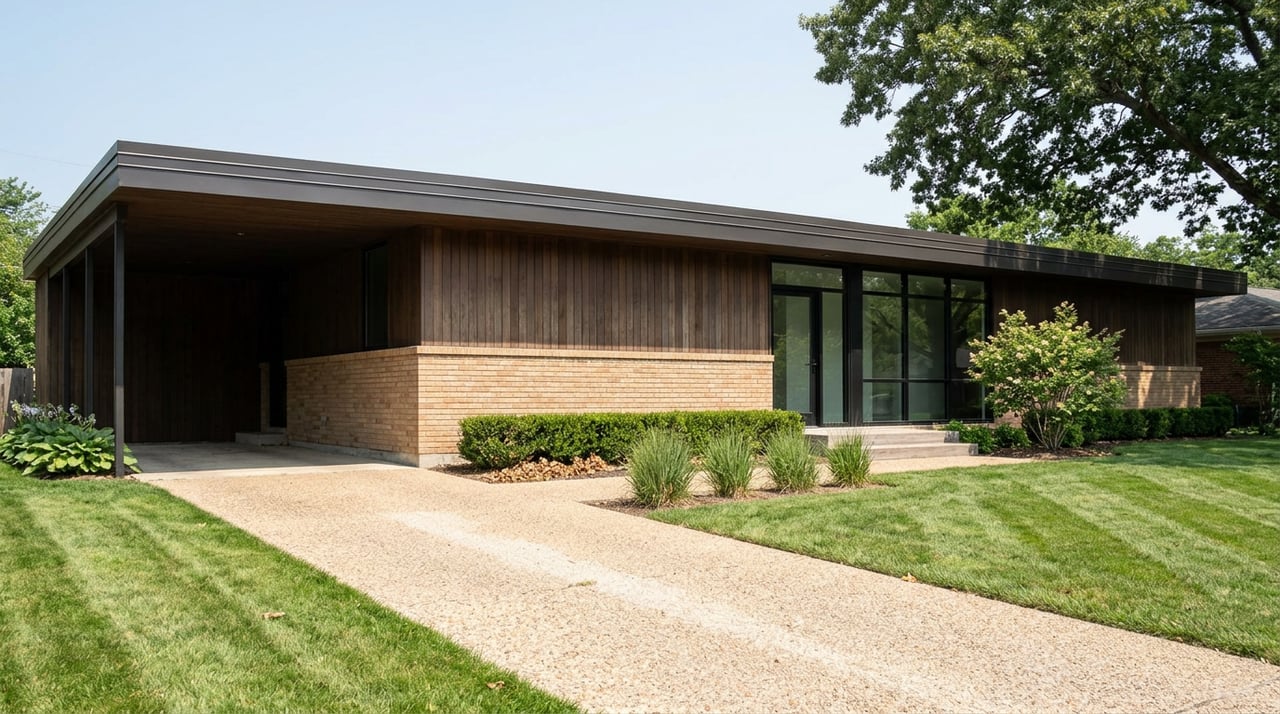
Worth flagging: the Harrison Lake examples that occasionally surface in this style skew toward larger, lake-adjacent estate properties, several thousand square feet with private docks and multiple wings, and they are not representative of what a typical mid-century modern buyer will find. The more ordinary stock, modest ranch homes with open floor plans and low rooflines, tends to sit closer to downtown in established, unassuming neighborhoods like Easterbrook Plaza, a quiet, walkable pocket residents describe as green and family-friendly rather than architecturally curated.
The Real Floor Under the Price
If architecture tourism isn't propping up Columbus home values, something else is, and that something is Cummins. The company was founded in Columbus in 1919 and remains the county's largest employer, with the Miller family's wealth and civic investment (including the architect-fee program behind those seven landmarks) tracing directly back to it. As of late August 2026, the average pay for a Cummins engineer in Indiana ran about $96,824 a year, according to compensation data tracked by ZipRecruiter.
That single-employer wage floor matters more for day-to-day home prices than any architecture award. And yet even that floor doesn't push Columbus into premium territory: the city's overall median household income sits at roughly $77,732, a touch below the national median of $83,181. Columbus reads less like a design enclave propped up by wealthy transplants and more like what it actually is, a solid, unglamorous engineering town that happens to have inherited an extraordinary set of public buildings from one company town's civic generosity two generations ago.
If You're Timing a Visit Around the Architecture
One more practical wrinkle worth knowing before you plan a trip or a move around the design scene. Exhibit Columbus, the city's flagship public art and architecture program, runs on a two-year cycle, and 2026 is not an installation year. The organization is spending its tenth anniversary on what it calls Fieldwork, a season of reflection and planning rather than new outdoor commissions, with the next full exhibition cycle beginning in spring 2027.
That doesn't mean the design conversation went quiet this year. Earlier in 2026, the Landmark Columbus Foundation, which runs Exhibit Columbus alongside its preservation programming, held a full winter calendar of public talks, including Progressive Preservation Talks on the historic Goins Hotel and on local figure Granville Lee, staged at the Crump Theatre. If you're weighing a visit purely to see new commissioned work outdoors, 2026 is a quieter year. If you want to understand the history behind the buildings, this has still been an active one.
A Few Quick Answers
Can I buy a Saarinen-designed house in Columbus? Not currently, and not easily even if the market shifts. The Miller House, the one Saarinen residence with real name recognition, is a museum property accessible only through guided tours, not a private listing.
Is 2026 a bad time to visit Columbus for the architecture? Not bad, just different. There is no new outdoor installation cycle this year since Exhibit Columbus is in its Fieldwork planning season, but the landmark buildings themselves and the Landmark Columbus Foundation's talks are running as usual.
Do mid-century modern homes in Columbus appreciate faster than the rest of the market? Current listing data doesn't show it. As of September 2026, homes tagged mid-century modern are pricing within a few thousand dollars of the citywide median, not above it.
If you're weighing Columbus against other Indiana towns and want to know what a specific price point actually buys here, whether that's a Donner Park ranch or something new further out, The Nolting Team can walk you through the current inventory and put a real number on what your budget gets. Start with a home value estimate and we'll take it from there.